START TRIMMING NOW!
Start trimming back now your ornamental grasses (like purple fountain grass and muhly grasses), trees, woody shrubs and vines (except indian hawthorne, azaleas, carolina jasmine that bloom in early spring). I would recommend waiting on the tropicals just a few more weeks, just in case we have a late cold snap.
WAIT TO FERTILIZE YOUR LAWN.
We all want our lawns to look lush and green all the time but it can’t be in the winter. Don’t think you can “wake up your grass” with fertilizer; fertilizer is taken up with growth, and since the grass is still dormant, it will do no good to feed now. It is best to wait until the grass comes out of winter dormancy which is usually mid March. The best way to tell when to feed is when you need to mow the grass (and not the weeds) every week or so. If you wait to feed, you will see the results you are looking for. It’s also best to attack existing weeds in warm weather (not hot) and sunshine. Since February can be our coldest month, it is usually March before we can take care of those weeds. My thought is, kill the weeds in early March and then fertilize the lawn afterwards. There is no sense in feeding the weeds.
PLANT WILDFLOWERS.
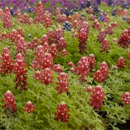
If you missed sowing your wildflowers in the fall, you can try to sow them out right
now. We also have bluebonnet plants in 6 packs ready to transplant, your favorite Ladybird Blue and Aggie Maroon. Seeds of sweet peas and nasturtiums can also be sown in the garden now for spring blooms.
 TIME TO PRUNE ROSES! Valentine’s Day is a time to remember our loved ones with candy and flowers. It also is the perfect time to prune roses. Late January to mid February is the best time. Prune established hybrid teas, removing dead and small twiggy growth, leaving strong healthy canes to a plant height of 18-24 inches. Try to prune to an outward facing bud to maintain spreading, open growth. Prune shrub roses like Knockouts 1/3 to 1/2 the plant height. Do not prune climbers until after the Spring bloom, then removing only the oldest canes and cutting back healthy, vigorous canes no more than 1/3. Remove spent blooms throughout the season on all rose varieties, cutting back to the first 5 leaflet cluster. You can also begin fertilizing your roses in late February with Bayer Systemic Rose and Flower Care, or organically with Maestro Rose Glo. Gill Landscape Nursery stocks disease resistant roses (ask for them), but if you have hybrid teas, as soon as new growth appears you should begin a spray program to control insects and diseases. Bayer 3 in 1 Insect, Disease and Mite Control, takes care of all rose problems. For organic controls, use Neem Oil for insects and disease or Serenade to control diseases. A regular spray program keeps your roses healthy and happy. Remember fungal diseases are always easier to prevent than to cure.



 inch wide. They are browninsh-gray to black with distinctive red markings. Boxelder babies have dull red bodies with black legs. You will find them by the hundreds, if not thousands gathered on the fence, in the bark of trees or hiding in your mulch. Adults deposit their eggs in cracks and crevices of tree bark in the spring, about the time buds begin to open. There are two or more generations per year in Texas. Boxelder Bugs are not considered to be damaging to host plants. Although they feed by sucking plant juices, they seldom cause harm to plants. They are considered more of a nuisance pest. You can choose to ignore them, or if need, they can be sprayed with any insecticide i.e. Cyonara or Triazicide. An organic alternative is Spinosad. –DeAnna

 grubs.


 Companion Plants For Your Veggie Garden
 Time to fertilize your lawn, trees & shrubs! Hopefully by the time you get this, the sunshine will have warmed and dried the soil enough to fertilize. Use Gill Lawn and Garden for all your trees, shrubs, vines and groun
 For weed control in your lawn, use Weed B Gon for St. Augustine. We have a new formulation that is safe to use on Floratam St. Augustine Grass. Treats up to 2500 sq. ft. and comes in a ready to spray hose-end bottle. Image will kill some broadleaf weeds (dollarweed) as well as a few grassy weeds (grassburrs) without hurting your St. Augustine. Another new product we have is Topshot. It also kills all broadleaf weeds in the lawn and comes in a package with 2 ampules which cover 5000 sq. ft. Simply add 1 ampule with water in either a pump sprayer or Dial n Spray to cover 2500 sq. ft.. For best results apply weed killers when weather is warm (not hot) and sunny for 3-4 days. Do not use in flowerbeds for weed control (except Image), only as a lawn application.