
 My mother, Ruth Gill, was a quirky but elegant, courageous yet tender, intelligent and curious woman. And I can put that in this blog because its Mother’s Day! But back to gardening, with just a few of her quirky twists.
When I was little, we lived on Hewit Drive, at that time the “fancy” neighborhood. One year, the grubs killed a large patch of the front lawn, and instead of rushing to plant new grass, she planted and harvested a crop of blackeyed peas. In the front lawn! On Hewit Drive! That’s seeing opportunity where others would not.
I often found her in the garden, pulling weeds, and eating them! Purslane was one of her favorites, and now one of mine. I grow it in a pot for a delicious and very healthy stir fry. She always said “The best revenge against a weed is to eat it.” Once we were camped on Matagorda Island with nothing left to eat but a can of tuna fish. She went for a walk and scoured up a mess of wild onion and peppergrass, and turned a boring can of tuna fish into a gourmet seasonal tuna salad.
Another time, she brought in some Giant Pothos ivy leaves which she arranged in a vase on the table. As a few days passed, I noticed brownish green pellets under the plant and looked more closely. There was a caterpillar munching on the leaves, and I was indignant to share my table with a munching and pooping caterpillar. When I told my mother there was a caterpillar, expecting her to be dismayed and pick it off, she instead replied “Yes, isn’t she just a marvelous artist? I love to watch her work, the changing pattern she makes in the leaves, new every day.” And of course she was right, she had a way of seeing and appreciating the marvels around us  that most people miss. I am so thankful to my mother for opening my eyes to the wonders of nature and gardening.
-James
 Time to treat for grub worms. Did you know, grub worms come from June bugs? Grubs are the larval stage of the brown June Beetle that flies around your porch light every Spring. If you notice a large number of these beetles, you may want to consider treating your yard with Bayer Season Long Grub Control. It works to kill grubs for approx. 3 months. Grub worms eat the roots of your grass during the early spring and summer causing the area to die. You can literally roll your lawn up like a carpet. If you have grubs each year, then it is likely you will have them again. Taking precaution now is better than waiting till late summer or early fall and seeing the damage already done. An organic solution is to spray out Beneficial Nematodes. Each sponge contains 5 million nematodes, enough to treat 2000 sq. ft. of surface area. Reapplying these nematodes monthly will help to build the population for effective control of grubs and fleas through the summer. If do not want to treat or are unsure if you have the problem, just watch your grass closely. Any areas that look dry and wilted but the rest of yard does not, it could be grubs. Dig down and look. If you find more than 4 grubs in one square foot of area, then you should treat with Bayer 24 hour. If no grubs are found, and
  the ground is hard and dry, then check your sprinkler to make sure it is watering that area as evenly as the rest of the lawn.
 Every year around this time, I think about how much my Mom has done for me. When I drive back home to visit her, I always look for her favorite flower (which of course is a weed!). Much to my Dad’s chagrin, I arrive home with a bushel full of Queen Anne’s Lace. If I could, I’d buy her enough Queen Anne’s Lace to make a whole bed of it for her, but generally nurseries don’t sell too many weeds! For Mother’s Day this year, instead of buying your Mom cut flowers, why not find out her favorite
  flower and come to Gill’s. We’ll help you take that flower and make a gift that lasts not just a few weeks, but for years.
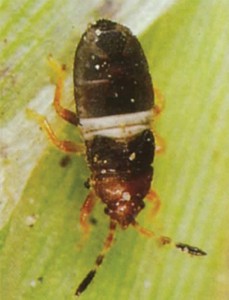 Seems a little early with all the rain, but the temperatures are right on up there where they should be for May. I am seeing lots of damage to the lawns and finding chinch bugs. Areas of the lawn will look dry, especially near the sidewalk or driveway where it is the hottest. If you dig up a shovel width piece of lawn and shake it over white paper, you will see small black bugs with a white stripe across their back. The old method was to cut the bottom out of a coffee can and push it into the soil of the dry area, fill it with water and the chinch bugs would float. Try finding a metal coffee can these days! You can spray the areas with Cyonara,
  stay away from them until the days get longer and drier. With rain and heavy moisture in the air, they suffer from Phytophthora, an airborne fungus, and die within days. We promise we will get them in as soon as conditions permit!!
 away from the patio at least another 2″ out into the yard to get the water flowing away from the house. That would leave you