
I’ve had quite a few calls recently about back yard drainage problems. The first two solutions people tend to ask about are “French drains” or filling the low spots. These might end up being part of the solution, but are not the best place to start. The best solution is usually a swale, which is a wide, safe, aesthetically acceptable ditch.
When rain starts falling, it has to go somewhere. If you have a low spot in the back yard, that is where it will go. If you fill that low spot, where will it go now? Unfortunately, many people find out that it will now go onto the patio or into the house or garage.
If you place a drain in the bottom of the low spot and attach a 4″ drain pipe set into a ditch that is carefully and continuously sloped out to a lower exit point in front, you can successfully carry water out of the back to the front. But you are limited, first by the diameter of the pipe (and the intensity of recent rains certainly have exceeded the carrying capacity of a 4″ pipe) and secondly, by the intake drain, which will be quickly clogged by leaves, sticks, and other organic debris floating on the flood water and carried to the drain. So the water will eventually drain out, but intense rainfall overwhelming the system may rise and flood the house before the rain lets up. So, a “French drain” may be a good solution for nuisance water standing in the yard, but a bad solution for potential water flooding the house.
A swale has a much higher carrying capacity, and if kept clear of clutter, is unlikely to clog from the organic debris that is carried on the flood water. Start by finding the amount of drop from the back patio or finish floor grade of the room that floods, and the point of the front sidewalk that the water will have to cross to get to the street. Let’s just say there is a 12″ drop. You can find your grades by renting a builder’s level (I use a ZIPLEVEL altimeter), or you can set up a series of stakes, strings, and line levels (not quite as accurate, but better than eye-balling). Then measure the distance that water will have to travel, and let’s just say the distance is 80 feet. You would like to have a 2″ drop from the patio to the lawn, and then have the lawn slope  away from the patio at least another 2″ out into the yard to get the water flowing away from the house. That would leave you 8″ of drop to move the water around the side and out to the front sidewalk, so you would dig your swale to drop 1″ every 10 feet until you get to the front sidewalk. Hopefully you do not have concrete poured all the way out to the side fence, or a big oak tree with massive roots in the way. If you see your way clear, then start digging! Remember if you want to re-sod the swale, you will need to dig 1″ deeper than finish grade to allow for the thickness of the sod. If you still have spots holding water that are lower than the swale, now it is safe to fill them so the water flows into the swale and out to the front.
-James
 No treatment is necessary since the nesting period of the female is usually just a couple of weeks. The scalloping of the leaves will not kill your plants, it just leaves them unsightly to some. These bees are great pollinators, so I say, “let them do their thing”.
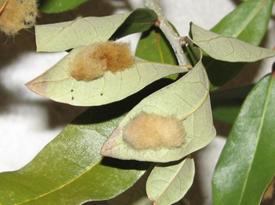 All from a shiny reddish ball. Or a fuzzy white ball. Or a corky brown ball. I’m talking oak galls, which commonly strike terror into the hearts of live oak tree owners this time of year. They are all caused by various species of small, stingless, solitary wasps. These wasps insert an egg (or several) into the tissue of small oak branches or young leaves, and are thought to modify the DNA of the plant, forcing the plant to produce growth (the gall) that supplies both housing and food to the wasp larvae living inside. The saliva of the wasp applied at the time of the egg laying is thought to contain a virus that produces the genetic changes, so wasp larvae have been eating GMO’s for millions of years.
 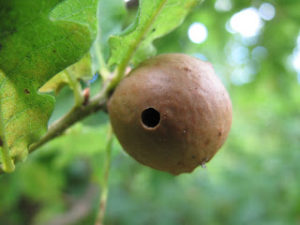 So wasps are defacing and eating your oak tree this summer, what you gonna do about it? As one writer says, “I recommend a cold drink, a good book and a comfortable chair.” ‘Cuz there’s nothing you can do or should do about it. Oak galls come in periodic waves, a few one year, more the next, and none the year after.
  James
James