
 Aphids on Milkweed: If you plant tropical milkweed to help the monarch butterflies (and for the beautiful flowers) sooner or later you will get aphids. You can hose down the infested milkweed tips with a sharp stream of water, knocking most of the aphids off (away from your other plants please). But if you see a substantial number of aphids looking brown and bloated instead of just fat and sassy, you may choose to
leave them alone. The brown, bloated ones have been parasitized by a tiny braconid wasp, whose larvae will eat the insides of the aphid, metamorphose into a wasp, and hunt down scores of aphids to lay eggs on, continuing to destroy aphids with no supervision from you. -James

Too much rain on roots? My walking buddy sent me a photo of her unhappy Jatropha and wanted to know what the problem was. We believe the constant moisture over the last few months caused the roots to rot which caused the plant to drop foliage (a plant is programmed by mother nature to drop foliage if roots are suffering).
Now that the sun is out and soils are drying, we recommended she cut the plant back one half and be stingy with watering. Most likely it will flush with new spring foliage and be good to go.
-Sally

Caterpillar alert: I have had several customers bringing me Tussock Moth Caterpillar from their oak trees. The creamy white hairs on the caterpillar are long and bristle-like and spread out in tufts down the sides. Two long, sharp black pencil like hairs protrude near the front and rear and these hairs are connected to poison glands, which excrete venom on contact. Contact with the venom may result in itchy irritation. You can spray your tree with Hi Yield Thuricide Concentrate or Natural Guard Spinosad Hose-end. We also carry Spinosad in a concentrate Fertilome Borer, Bagworm, Tent Caterpillar and Leafminer Spray. Both of these products are organic and safe to use on all plants. Thuricide
 reacts with the cells of the stomach lining of the target pest causing them to not be able to feed within hours of ingesting. They eventually die from starvation. Spinosad is a contact kill, but still safe and organic for all plants. reacts with the cells of the stomach lining of the target pest causing them to not be able to feed within hours of ingesting. They eventually die from starvation. Spinosad is a contact kill, but still safe and organic for all plants.-DeAnna |
spinosad


Last chance to kill those pesky lawn weeds.
The new formulation of Weed B Gon is totally safe on all lawn grasses including Floratam St. Augustine. The past few weeks of rainy weather has made it difficult to treat, but you must do it soon before our daytime temperatures exceed 90 degrees. It comes with the easy hose-end sprayer and covers 2500 sq. ft. Enough to treat the average front or back yard.
Got Fleas?
You do not have to own a pet to have a flea problem. Squirrels, night rats, and possums all carry fleas.
The best way to treat for a flea problem is the 3 step process: treat the pet, treat the house, treat the yard. Check with your veterinarian for the best treatment for your pet. For the house, we carry several different products.
Crawling Insect Killer (Diatomaceous Earth) is a naturally occurring, soft, siliceous sedimentary rock. It works by scratching the exoskeleton of insects, causing them to dehydrate and die. It lasts a long time when kept dry. Take caution not to breathe it in when vacuuming floors.
Essentria Broadcast Insecticide Aerosal kills adult bedbugs, fleas, and dust mites and their eggs. It contains natural essential plant oils that are safe and effective for the home. A light uniform spray to all surfaces is recommended. Re-apply in 14 days as needed. The last step is to treat the yard. Usually any pesticide labeled for lawns and landscape plants will also kill fleas and ticks.
We carry Spinosad, an organic treatment for lawns, in both a concentrate and ready to use spray. I usually recommend treating every 4- 5 days for 3 weeks to kill any re-hatching of eggs. Be sure to spray garages, decking, fences and doghouses, anywhere fleas may breed.
Another organic alternative is to apply Beneficial Nematodes. Beneficial Nematodes are microscopic warriors that kill soil borne pests such as flea larvae and grub worms. They
search, find, and kill pests living in the soil. They are extremely effective, and will reproduce and spread to provide you with long lasting organic pest control. We do recommend applying once a year to build the population. Each sponge contains 5 million nematodes, enough to cover 2000 sq. ft. of surface area.
 – DeAnna
Watch out for Chinch Bugs!
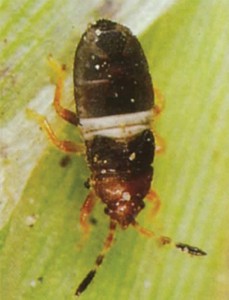 Seems a little early with all the rain, but the temperatures are right on up there where they should be for May. I am seeing lots of damage to the lawns and finding chinch bugs. Areas of the lawn will look dry, especially near the sidewalk or driveway where it is the hottest. If you dig up a shovel width piece of lawn and shake it over white paper, you will see small black bugs with a white stripe across their back. The old method was to cut the bottom out of a coffee can and push it into the soil of the dry area, fill it with water and the chinch bugs would float. Try finding a metal coffee can these days! You can spray the areas with Cyonara,
  Triazicide, even Mosquito Beater Hose-end will kill chinch bugs. You do not have to spray the whole lawn, just the areas affected. The grass will quickly recover. For an organic control, use Spinosad or Diatomaceous Earth.
-DeAnna
Periwinkle Update
We are holding off on bringing in periwinkles (one of our favorite, most reliable annuals!) due to the rain patterns we have been having, and we encourage you to  stay away from them until the days get longer and drier. With rain and heavy moisture in the air, they suffer from Phytophthora, an airborne fungus, and die within days. We promise we will get them in as soon as conditions permit!!
-Sally
You may have already done several items on this list, but with all the recent rains they may have been depleted or washed away, therefore another application may be necessary.
- Fertilize the lawn, shrubs, trees and tropicals again with Gill Lawn & Garden or Milorganite.
- Continue to feed vegetables and herbs with Espoma Plant Tone. Citrus and fruit trees with Espoma Citrus Tone.
- Apply pre-emergent again to prevent weeds, Amaze or Dimension.
- Spray post-emergent again or as needed to kill existing weeds, Weed b gon or Image. You could also keep the weeds mowed before they go to seed. Most will die with the heat.
- Drench Hackberry trees for wooly aphids, bougainvillea for caterpillars, hibiscus and jatropha for mealybugs etc.. with Bayer Protect and Feed to prevent insects for 9 months.
- Treat the lawn with Bayer Season Long Grub Control or Beneficial Nematodes.
- Watch for Chinch bug activity in the hot dry spots of the lawn near sidewalks and driveways. Spray with Cyonara or Triazicide. For organic control use Spinosad or Diatomaceous Earth.
- Treat for fungus. Check the lawn for brown patch. Roses, Crape Myrtles and Gerbera Daisies for powdery mildew and Plumeria for rust. Use F-stop, Serenade or Actinovate for the lawn and Fertilome Systemic , Serenade or Actinovate for plants.
- Plant sun or shade loving heat tolerant flowers and tropicals.
- Mulch everything including potted plants to prevent weeds and hold moisture for the summer.
-DeAnna
Organic Insecticide: Insecticidal Soap is based on potassium fatty acids and is used to control many plant pests. Because insecticidal soap only works on direct contact with the pests, it is important to thoroughly spray the entire area of the plant where you see the pests. It is used to kill aphids, scales, whitefly, mealybugs and spider mites.
Some plants can be sensitive to it, so be sure and read the label before spraying. (You should spray a small part of the plant, wait a couple of days to see if there is any reaction before you spray the entire plant.) It also cannot be sprayed when the temperatures are above 90 degrees. I usually recommend to spray in the early evening once the plants are in the shade. This gives them all night to dry before the sun hits them the next day. The same is true for Neem Oil. It works to kill and repel a wide variety of insects.
It also can be used as a fungicide and miticide. Neem Oil is not known to be harmful to mammals, birds, earthworms or some beneficial insects such as butterflies, honeybees and ladybugs if it is not concentrated directly into their area of habitat or on their food source. Spinosad is another insecticide used to kill borers, bagworms, caterpillars, leafminers, thrips, fleas , scales and beetles to name a few.
It is also available in a granular bait form to kill fire ants. And lastly Diatomaceaous Earth. This is a powder used to scratch the exoskeleton of insects causing them to dehydrate and die. Works on roaches, fleas, pill bugs, ants and more. Depending on what insects you are trying to control, we can help you find the best product to meet your needs.
-DeAnna
The asps are out! It’s been years since we’ve had a big asp outbreak. These stinging hump back caterpillars love oak trees, yaupons hollies, burford hollies, hawthorns, altheas, and hibiscus. I saw a fresh hatching no bigger than a pea on some hollies the other day. Take a close look at your plants and see if you find any skeletonized leaves. Spray thoroughly on the tops and bottoms of the leaves with Spinosad, or Liquid Sevin as a contact kill. Thuricide can also be used, but the caterpillar has to ingest the leaves to be killed and that takes a couple of days.
Leafcutter bees are also a problem now. These bees are generally passive and not very aggressive. However they can sting and will do so if handled or aggravated. You usually never see the bee, but you do see the damage left behind. They cut perfect semi-circles out of the leaves of soft tissued plants such as crape myrtles, hibiscus, plumbago and roses. We first noticed the damage on our kapok trees. They take the leaves and roll them into perfect tubes to block their nest openings. No treatment is necessary since the nesting period of the female is usually just a couple of weeks. The scalloping of the leaves will not kill your plants, it just leaves them unsightly to some. These bees are great pollinators, so I say, “let them do their thing”.
-DeAnna
Remember to rotate your crops from last season if possible. Also do not crowd your plants. Insects and disease love places that are overcrowded with no air circulation. Spacing your plants will limit the areas for the bugs to hide.
There are many organic options to keep insects and disease under control. For insects, use Insecticidal Soap for soft-bodied bugs, Spinosad for beetles, caterpillars, and leafminer. To prevent powdery mildew on curcurbits and cole crops, use Serenade or Neem Oil, when it comes to disease, it is always easier to prevent than to cure. Also, mulching the garden with Hardwood Mulch or Pine Straw will keep fungal spores from splashing up onto the plants.
Fall can be the best season for growing vegetables due to the cooler weather and more rainfall, unlike the spring garden where we are heading into the hottest season. So plant now, space things out, keep the garden weed free, fertilize regularly and be a good bug scout. And remember, only spray insecticides if necessary. We do not want to kill the bees or other pollinators in the garden.
-DeAnna
The weather was warm & dry last week and I have been watering a little each morning and evening. It is keeping our plants perky. I did our first Hastagro feeding on October 17th, after fixing my cutoff hose with a new end and invested in a new hand sprinkler. My old one was used as a chew toy. Even though we hoed and pulled weeds before prepping our garden….guess what’s already coming back? The war is coming and I am hoping to have a new secret weapon to use…its organic, smells great and it works….more on that soon. Our seeds are sprouting nicely; all the transplants doing well, the mystery chewers have found the swiss chard already. Think I’ll start with a pan of beer for snails and slugs. If that does not fix it, I will try Dipel Dust or Spinosad. Both are natural and very effective for most chewing critters!
Maybe then I’ll drink the beer☺
 -Debbie